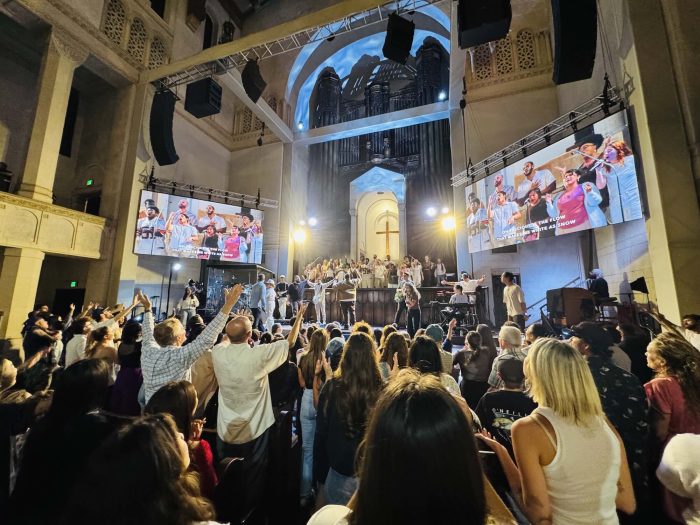

Have you ever stood next to someone in church and wondered about their story? Not just what you can see, but what you can’t.
The similarities and differences: how you grew up, what you’ve walked through, and how your lives have unfolded.
Maybe you’ve gone deeper.
Same room. Same church. Same moment. But a completely different experience.
I’ve been thinking about that lately. How easy it is to assume we know someone’s full story, and how often we don’t. If we’re honest, we all do this.
In a world full of conversations about unity, belonging, difference, and division, it can feel complex, layered, or even overwhelming.
But what if it’s actually much simpler than we think?
When Jesus was asked to name what mattered most, He didn’t give a long explanation. He didn’t list every command. He didn’t unpack every nuance.
He said, “Love the Lord your God… and love your neighbor as yourself.”
And then He added something profound: “All the Law and the Prophets hang on these two commandments” (Matthew 22:37–40 NIV).
Recently, Muchiri Gateri and I sat down for a conversation where he reminded me of this clear calling. Muchiri has been part of our church since 2003 and serves in a national role across Australia.
He said, “I think this conversation, unity and belonging, at its core, at least in my estimation, is really a conversation around loving your neighbor.”
He continued:
It’s a call to love my neighbor.
It’s a call to forgive as I have been forgiven.
It’s a call to be my brother’s keeper.
This is what it all comes down to.
What if we all approached it this way?
For me, this has looked like slowing down enough to see the person in front of me, not just the role they play or the space we share, but the story they carry.
It has looked like recognizing that even in the same room, the same church, the same moment, someone else may be experiencing something very different than I am.
To see unity and belonging as a God given calling, in part, where His justice is daily lived out. It starts with seeing every individual as a human being created in the image of God, and being intentional about building a church where everyone experiences their God given value within the context of their human existence.
This requires something from us. More than we might first realize. And Muchiri offers a deeply transformative starting point, one that challenged me.
I asked him, “How do we steward this better?”
His answer?
We start by getting on our knees.
If I’m honest, this is the part I don’t always want to rush toward.
Linger in that for a moment.
He shared that without prayer, we do not have enough within us to see what we need to see, to respond the way we need to respond, or to walk as sensitively as we need to.
Prayer does two things. It invites Him, and it empties us of us.
Without humility that begins with surrender, and without the help of the Holy Spirit, we will likely get it wrong. Even our boldness or empathy can come from the wrong place if it is not rooted in Him.
Which is why this is not just a conversation. It’s a formation.
Muchiri then pointed to the thread from the Old Testament to the New Testament. The Gospel in its very foundation is a work of reconciliation.
That’s what the cross is.
At its core, the cross is a work of reconciliation: a holy God reconciling sinful humanity back to Himself through Christ. Not because we earned it, but because He chose to move toward us first.
I find myself asking, do I live like that toward others?
Since what God has done is our model, it becomes our invitation.
Unity and belonging look like sacrifice, dying to ourselves, preferring the other person, and choosing a future that reflects the heart of God.
From beginning to end, Scripture shows us that God is patient, intentional, and sacrificial. And in response, we are invited to decenter ourselves, remembering that we are not the center of the story. We are participants in it.
As we finished our conversation, I asked him, “What’s part of your dream for Hillsong Church when it comes to unity and belonging?”
He shared, “In many ways, we are already living it.”
“On any given Sunday, across many of our global locations, we see it. Different cultures, races, and languages coming together, worshipping God as one body.”
I’ve seen this personally in many moments, standing in a room where different languages are spoken, different cultures are represented, and yet we are worshipping one God with one voice.
Moments where you can feel it.
This isn’t something we created, it’s something God is doing.
A glimpse of what Scripture promises:
“After this I looked, and there before me was a great multitude that no one could count, from every nation, tribe, people and language, standing before the throne and before the Lamb…” (Revelation 7:9 NIV).
This isn’t just a future promise. It’s a present invitation for the Church now.
So how do we steward this divine design?
We keep unifying ourselves. We keep centering ourselves on Jesus. We keep celebrating the uniqueness of what God has placed in each person. We keep preparing ourselves for the work of the ministry.
And as we do, we begin to model this to the world. We become what Jesus described: “a city on a hill that cannot be hidden” (Matthew 5:14 NIV).
A people so shaped by His love, so transformed by His Spirit, that the answers the world is searching for, unity, belonging, and reconciliation are not just spoken about, but seen, lived, and experienced.
Not perfectly, but intentionally.
This is who we are becoming.
What matters most is love. When we live it, unity and belonging stop being a future vision and start becoming a present reality.
A church that says with every word and action:
Welcome Home.
You belong here.
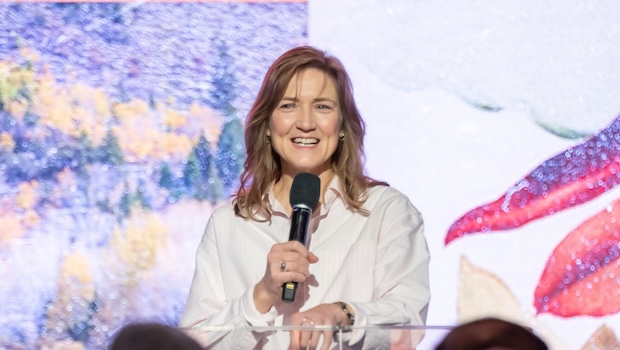
Unity & Belonging Program Manager
Maria Hansen-Quine
Hillsong Church is a multi-generational church made up of people from richly different backgrounds—committed to unity and belonging centered on Christ. We are intentional about building a church where people of all ages, stages, cultures, backgrounds and abilities participate fully in the body of Christ—in line with how Jesus prayed (Jn 17:22-23), with what the early church modeled (Acts 2, Gal 3:28) and with what heaven will be like (Rev 7:9). This commitment is part of our vision to be a healthy church changing lives through Christ. As part of our Welcome Home Value, we are invitational—creating warm environments where every one is valued.
 Sep 1 2026